
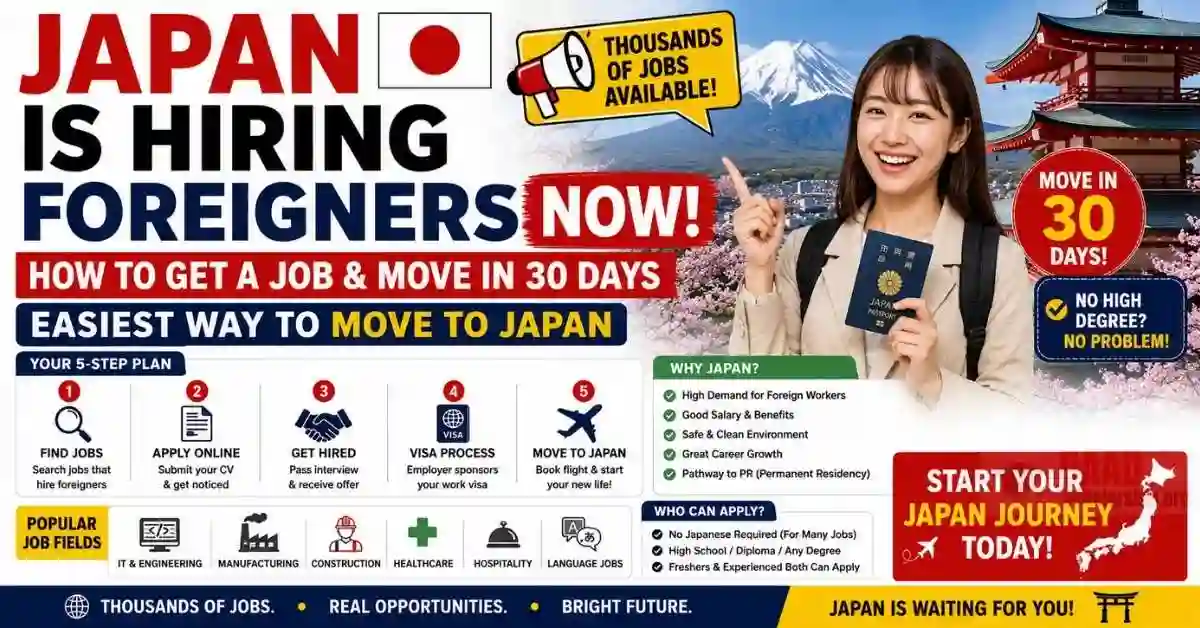
Thinking about moving to Japan for work? Well, whether you’re in tech, teaching, or finance, Japan is opening its doors like never before. In this article, I’ll walk you through exactly how to get a job in Japan as a foreigner, the salaries that you can expect, visa options, and top job boards that you should use in 2026.
Check,also: Malta Seasonal Worker Permit 2026—A Complete Guide
Japan’s Growing Demand for Foreign Workers
Japan’s economy in 2024 saw rising costs of living and stagnant real wages. Even though companies raised salaries by around 5%, real income still dropped because of inflation.
But here’s what’s interesting. Japan is hiring more foreign workers than ever before. In 2024 alone, over 7.2 million visas were issued. Amongst these, the specified skilled worker visa saw massive growth, with over 284,000 workers now in Japan under this category. And guess what? The total number of foreign workers in Japan hit a record 2.3 million.
Check, Also: Croatia Supermarket Jobs 2026 – with Visa Sponsorship | Salary €1,200 Monthly
Average Salary in Japan
The average salary in Japan is around 4.5 to 5 million yen a year. That’s roughly around 30,000 to $33,000. In Tokyo, it’s higher, around $6.9 million or $47,000 annually.
Cost of Living in Japan
And what about living costs? For a single person, it’s around $160,000 yen a month. That’s around $1,100. And for a family of four, you can expect to spend around $420,000 a month. That’s around $2,800 in Tokyo. Of course, less in smaller cities.
Highest Paying Jobs in Japan
Now, if you’re wondering about the highest-paying jobs in Japan. Investment bankers earn around 38 million yen a year. Doctors and surgeons make around 20 to 40 million a year.
Software engineers make around 7 to 10 million a year. Executive-level roles get around 25 million a year. But even mid-level professionals like engineers, IT consultants, and finance specialists are in demand with salaries between 5 and 9 million.
Most Common Jobs for Foreigners
Here’s where you come in. The most common jobs for foreigners include English teachers, who earn around 3 million yen a year; IT engineers, with 4.5 to 9.5 million a year; and jobs like translators, recruiters, SAP consultants, mechanics, risk analysts, and business analysts, which are also popular.
You don’t always need to speak fluent Japanese, especially for IT, finance, and teaching jobs, but it definitely helps.
How to Land a Job in Japan
Now, here’s how you can land that job. The first thing you need to do is update your CV and tailor it to Japanese formats. Do remember to use certain Japanese words that, of course, you can Google to just make it stand out. And secondly, why not learn some Japanese?
It gives you a massive edge if you are seriously considering Japan. An N1 or an N2 gives you a massive edge, but even an N3 will help you. Also, remember to apply to foreigner-friendly companies, especially those that are willing to sponsor your visa. And do remember to prepare for interviews. Japanese interviews value punctuality, humility, and a cultural fit.
Pro Tips for Job Seekers
Here’s a pro tip. Remember to network on LinkedIn and don’t ignore smaller cities. Jobs are opening much beyond Tokyo.
Top Job Portals in Japan
Now, these are the top 10 job portals that you should definitely consider if you’re seriously looking for that job in Japan. There’s Gajun Pot, Japan Dev, Die Job, Career Cross, Tokyo Employment Services for foreigners, Work Japan, LinkedIn, and Robert Walters. Of course, there’s also Interact, which is for English teachers.
Work Visa Options in Japan
When it comes to visas, Japan offers several visa options. There’s a specified skilled worker visa for hospitality, caregiving, and manufacturing roles.
Then there’s the engineer or specialist in humanities or international services visa for IT businesses and marketing. There’s also the highly skilled professional visa, which is a fast track to permanent residency. There’s also the teacher visa, which is popular for ALT and Eka teachers.
Japan Work Visa Process
And here’s the process. You first need to land a job offer from a Japan-based company. Your employer then applies for a certificate of eligibility. Once approved, you apply for your work visa at your local Japanese embassy. Upon arrival in Japan, you would need to register your address and get your residence card.
Final Thoughts
Japan is changing fast, with 2.3 million workers already here and a record high visa approval. The opportunities have become better than ever before. So whether you’re a teacher, a coder, or a business analyst, there’s always a role for you waiting in Japan if you know how to get there.
Take care to avoid fraudsters!
🚫 You should never pay someone for a job application, an interview test, or an interview. A genuine employer will never request payment.